
A new Weed Science Society of America research article finds that AI-equipped sprayers can more efficiently control weeds than conventional broadcast sprayers

WESTMINSTER, Colorado – 21 January 2026 – A Weed Science Society of America (WSSA) journal, Weed Science, recently published a research article showing that smart sprayers with artificial intelligence (AI) capabilities can help reduce foliar herbicide use and their costs for Midwest corn and soybean producers. The study reviewed field experiments conducted during 2022 and 2023 near Manhattan, Kansas, and during 2023 near Seymour, Illinois.
“This research demonstrated that significant herbicide use reductions are possible with smart sprayers compared with broadcast applications,” reports Anita Dille, Ph.D., WSSA member scientist, corresponding author, Kansas State University agronomy professor, and her research team. “However, … incorporating integrated weed management principles with this technology, which includes crop rotations, use of residual herbicides, ensuring multiple effective sites of action for the dominant weed species, and two-pass herbicide programs, is still very important.”
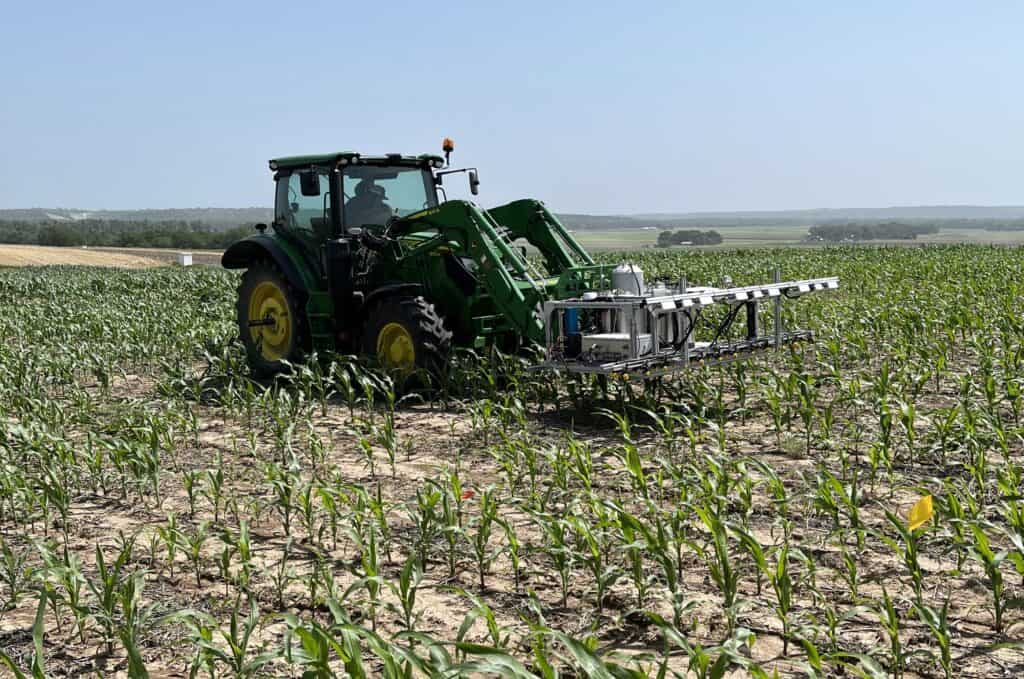
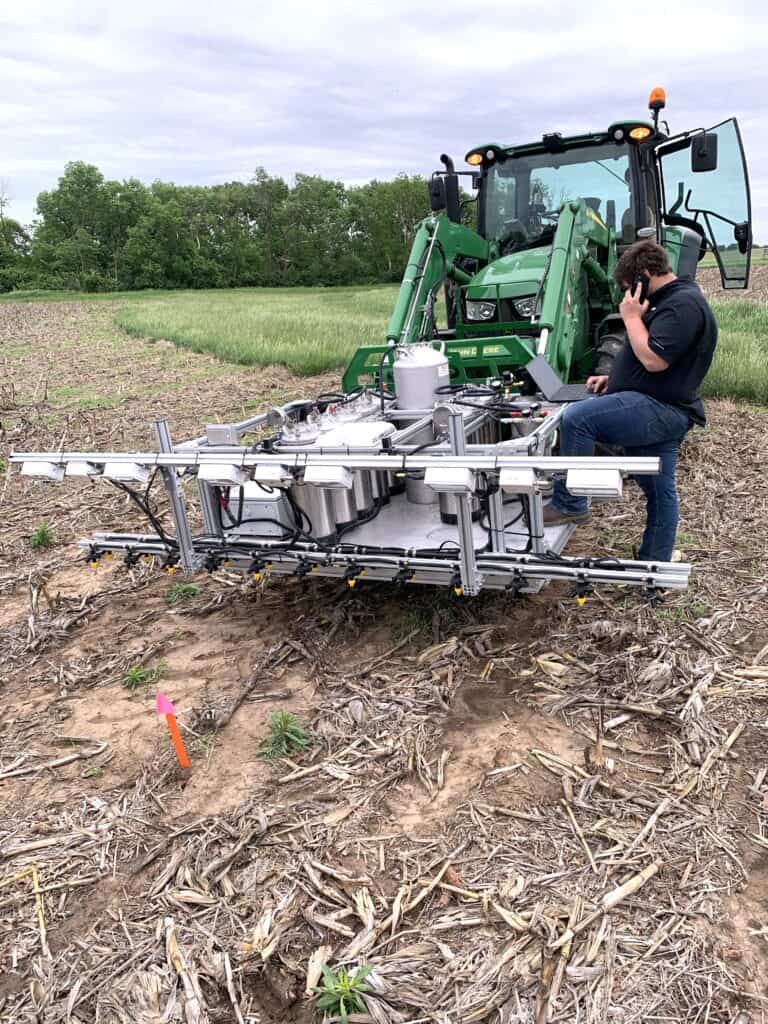
The researchers used a ONE SMART SPRAY sprayer for their study, relying on the same external hardware as a commercial unit, but custom-built for small plot research. The researchers then mounted the sprayer to a tractor and equipped it with a front boom reserved for spot spray nozzles and a rear boom reserved for broadcast applications. Cameras mounted across both booms used advanced imaging technologies that allowed the sprayer to distinguish between row crops and weeds.
“The ONE SMART SPRAY sprayer demonstrated the potential to reduce herbicide input costs without compromising weed control,” notes Dille. “As expected, herbicide costs in targeted spray applications were less than in broadcast applications.”
AI technologies enabled the smart sprayer to detect and spray the weeds between and in the rows and activate one or more nozzles across the boom, depending on the green area detected by each camera. For burndown/pre-emergence applications, the system did not rely on AI, but on infrared and near infrared technology that easily detects green vegetation.
“Broadcast applications of residual herbicides and multiple passes of targeted foliar herbicides are still important when using this technology,” emphasizes Dille. “Growers would benefit from the use of two-boom, two-tank smart sprayers for these simultaneous applications as they become available on the market.”
Yet, corn and soybean producers would still benefit by following some of the herbicide programs evaluated in the study, even without AI-equipped technology. For example, “a traditional one-boom, one-tank system would still work well with two passes across the field, first using a soil-applied residual product at planting, followed by a targeted postemergence application of foliar herbicides,” says Dille.
More information about the study is available online in the article: “Evaluating ONE SMART SPRAY for weed control in midwestern U.S. corn and soybean crops. The research article is among others recently featured in Weed Science, a Weed Science Society of America journal, published by Cambridge University Press. Dille can be contacted about the study at [email protected].
-###-
About Weed Science
Weed Science is a journal of the Weed Science Society of America, a nonprofit scientific society focused on weeds and their impact on the environment. The publication presents peer-reviewed, original research related to all aspects of weed science, including the biology, ecology, physiology, management and control of weeds. To learn more, visit www.wssa.net.
Media Contact:
Jo Skelton
Cambridge University Press
Senior Brand and Partner Communications Manager
01223326165