
Soil residual herbicide programs in Indiana resulted in no yield loss compared to programs without residual herbicides

WESTMINSTER, Colorado –23 July 2026 – Recently published research in the journal Weed Technology shows that early planted soybean fields nearly always resulted in higher yields than mid- to late-planted fields, and that any soybean stand reductions from using soil residual herbicide programs did not contribute to yield loss compared to herbicide programs without them.
The study’s researchers conducted field experiments during 2024 and 2025 at three Purdue Agricultural Centers (PAC) at latitudes representing northern, central and southern agricultural regions in Indiana. These sites included: the Pinney PAC, near Wanatah, in the north; the Throckmorton PAC, near LaFayette, in central Indiana, and the Southeast (SE) PAC, near Butlerville.
The experiments found that “an early planting date resulted in a greater yield than for mid-late and late planting dates at all site-years, except in SEPAC 2024,” states Estevan G. Cason, Graduate Research Assistant, Department of Botany and Plant Pathology, Purdue University, and the study’s corresponding author. “In that site-year, drastically lower temperatures after planting caused a 35% stand reduction in early-planted soybean compared with late planting, resulting in a 15% yield reduction.”
Overall, early planting during the field experiments correlated with slightly thinner (13 to 23%) soybean stand counts, when compared to later planting dates, but those reduced stands only reduced yields during SEPAC 2024. In addition, “early planting resulted in slightly more soybean injury (5 to 10%) from residual herbicides than later planting dates, but [that] did not translate into yield loss,” report the researchers. “The inclusion of residual herbicides at any soybean planting date, at either full or reduced rates, did not cause yield reductions compared with programs without residual herbicides.”
Other results showed that weed control with postemergence (POST) herbicides “was more challenging at early planting dates than at later planting dates, because early planting resulted in higher weed density at the time of POST application,” report the researchers. “Weed density and biomass at soybean harvest were also greater in early planting treatments than in late planting treatments, primarily because POST applications were performed earlier in the season, allowing for sequential weed emergence before soybean canopy closure.”
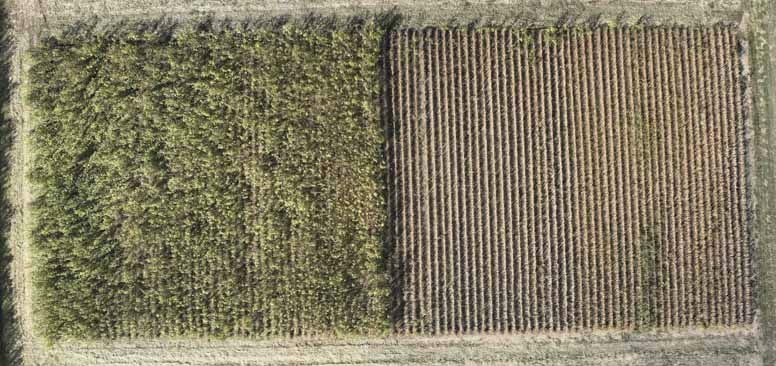
While early planting dates resulted in greater canopy coverage early in the season compared with late planting, this increased canopy coverage did not contribute to improved weed suppression. In fact, “early planting resulted in a 2.5-, 1.9-, and 2.4-fold increase in common lambsquarters, giant ragweed, and waterhemp density at POST compared with late planting, respectively, which resulted in greater selection pressure for herbicide-resistant weed biotypes with postemergence herbicides.”
Thus, “early planting achieved higher soybean yield, but created a more challenging scenario for weed control” for the future, sum up the researchers. “This suboptimal weed management scenario in early-planted soybean may lead to increased persistence of difficult-to-control weeds in the field and, consequently, greater selection pressure for herbicide-resistant weed biotypes.”
More information about the study is available in the article: Herbicide Programs for Weed Management in Early-Planted Soybean. This research article is among others recently featured online in Weed Technology, a WSSA journal, published by Cambridge University Press. Cason can be contacted about the study at [email protected].
-###-
About Weed Technology
Weed Technology is a journal of the Weed Science Society of America, a nonprofit scientific society focused on weeds and their environmental impact. Weed Technology publishes original research and scholarship in the form of peer-reviewed articles focused on understanding how weeds are managed. The journal focuses on applied aspects concerning weed management in agricultural systems, weed/crop management systems, new weed problems, new technologies for weed management, herbicides used to manage undesired vegetation, and special articles emphasizing technology transfer to improve weed control. To learn more, visit www.wssa.net.
Media Contact:
Jason K. Norsworthy, Ph.D.
Editor – Weed Technology
[email protected], 479-313-1265